
Google VERID Framework: AI Agents in Wet Labs
Discover how Google's VERID framework uses digital twins to enable AI agents to safely run biological experiments with improved accuracy and speed.
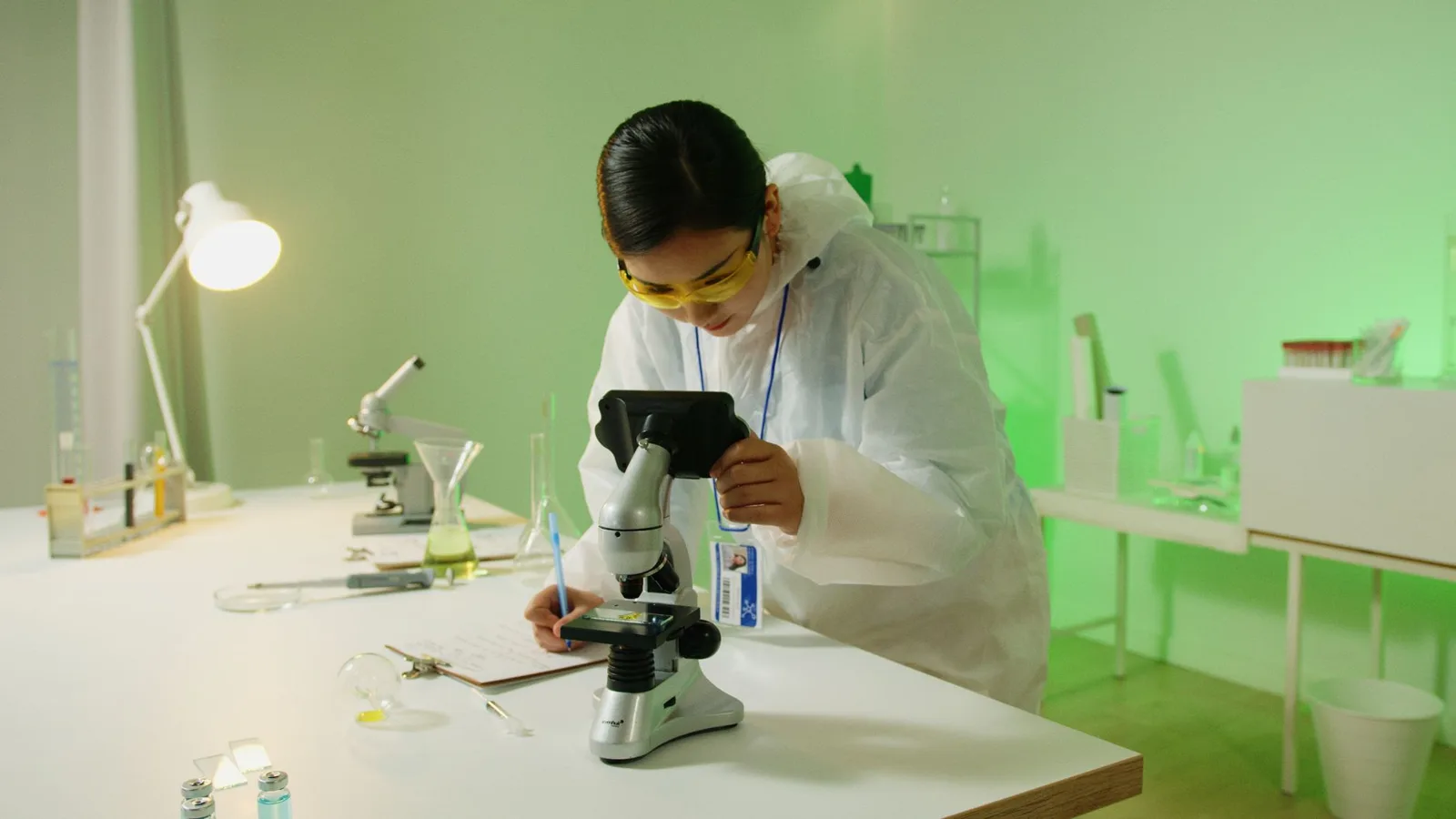
TL;DR: Google’s VERID framework uses digital twins to safely automate wet lab experiments, achieving a 42.1% aptamer hit rate and discovering high-affinity cancer binders. This bridges the gap between AI reasoning and physical robotics, accelerating biological discovery while highlighting current limitations in handling unexpected hardware errors.
Key facts
- Google Research introduced VERID (VERified Infrastructure for Discovery Laboratories), a digital twin system enabling AI agents to safely execute biological experiments in wet labs.
- VERID acts as a real-time 3D simulation layer tracking robotic arm positions, liquid volumes, reagent identities, and pipette tip inventories to prevent hardware errors.
- The framework achieved a 42.1% hit rate in aptamer development after just three experimental cycles, significantly outperforming traditional trial-and-error methods.
- VERID-enabled AI agents discovered protein binders with single-digit nanomolar affinity for an undisclosed cancer target through closed-loop experimentation.
- Limitations include undefined handling of unexpected physical errors like clogged pipettes and no announced plans for open-source release or API access.
How does Google’s VERID framework enable AI agents to run real lab experiments?
Google Research has developed the VERified Infrastructure for Discovery Laboratories (VERID) framework, a digital twin system that enables AI agents to safely execute physical experiments in biological wet labs. VERID acts as a real-time 3D simulation layer that tracks robotic arm positions, liquid volumes in wells, reagent identities, and pipette tip inventories [1][2]. This allows the system to perform virtual dry runs of experimental protocols in seconds, detecting potential collisions or empty wells before any physical action is taken. By simulating each step digitally first, VERID prevents hardware errors and serves as a critical safety layer for autonomous experimentation [4].
What measurable improvements have been achieved using VERID in biological research?
Using the VERID framework, Google’s AI agents achieved a 42.1% hit rate in aptamer development after just three experimental cycles—a significant improvement over traditional trial-and-error methods [4]. The system also successfully discovered protein binders with single-digit nanomolar affinity for a cancer target, demonstrating its ability to generate high-value biological molecules through closed-loop experimentation [1][2]. These results highlight the framework’s effectiveness in accelerating discovery by aligning digital hypothesis generation with physical validation. However, the specific cancer target used remains undisclosed in the published research [1][2].
What are the limitations and unanswered questions about VERID’s real-world reliability?
Despite its success, several key questions remain unresolved. The framework does not detail how it handles unexpected physical errors—such as clogged pipettes or sensor drift—that fall outside the scope of virtual simulations [1][2]. Additionally, no information is provided on the computational cost or latency of running virtual dry runs for complex protocols compared to standard execution times [1][2]. There are also no public plans announced regarding open-source release or API access for VERID, leaving researchers unable to replicate or extend the system [1][2]. While similar efforts like ProtoPilot (arXiv, June 2026) aim to automate molecular biology workflows across 294 tasks using multi-agent systems, they report different performance metrics—including a Top3 expert-preference rate and protocol-to-code gate pass rate—whose values are not specified in the available sources [5]. These differences suggest that while multiple teams are advancing autonomous wet labs, each approach uses distinct benchmarks and architectures without full comparability.
How does this fit into broader trends in AI-driven biological discovery?
Google’s work aligns with a growing industry shift toward autonomous laboratories. Ginkgo Bioworks emphasized in 2025 that the slow, manual generation of high-quality experimental data remains the primary bottleneck in scientific progress across healthcare and energy sectors [6]. This challenge is now being addressed through national initiatives like the U.S. Department of Energy’s Genesis Mission, which tasks major labs with building AI-driven discovery platforms that integrate supercomputing with autonomous experimentation [6]. VERID represents a critical step forward by solving the hardware-reasoning gap—where frontier AI models struggle to reason about 3D geometry and physical states necessary for liquid-handling robotics [1][2]. By enabling safe, iterative testing in real labs, VERID bridges the divide between digital design and physical validation, marking a shift from robotic interfaces to complex biological environments.
Sources
- Grounding AI agents in biological reality: Building blocks for autonomous wet labs (research.google) — 2026-10-14
- Grounding AI agents in biological reality: Building blocks for autonomous wet labs (research.google) — 2026-10-14
- Google VERID: AI Agents Run Wet-Lab Experiments (2026) | explainx.ai Blog — 2026-10-16
- A Self-Evolving Agentic System for Automated Generation and Execution of Biological Protocols (arxiv.org) — 2026-01-31
- Autonomous Lab | Ginkgo Bioworks (www.ginkgo.bio) — 2025-01-01