
Local LLM Benchmark on a 48 GB Dual-GPU Rig: What Actually Runs in 2026
We ran Qwen3 27B, 32B, 35B-A3B, and 80B on an RTX 5090 + 5080 box to find the real sweet spot for local AI in 2026. Here is which model fits which job — and which one to drop.
TL;DR: On a 48 GB dual-GPU rig (RTX 5090 + RTX 5080), Qwen3-Next-80B scored 100% on our 60-prompt brutal coding tier at 28 tokens/sec, while Qwen3.6-35B-A3B ran on a single 32 GB card (the RTX 5090) at 138 tokens/sec and hit 95% once given a 12k reasoning budget. Dense 32B and 27B models beat the original 30B-A3B MoE by 35-40 points on hard tasks — so the old MoE is the one to drop, and a three-tier setup covers the rest.
[Updated · 2026-10-14] Removed the sentences that tied this benchmark to the site’s own publishing system; the benchmark figures are unchanged.
Key facts
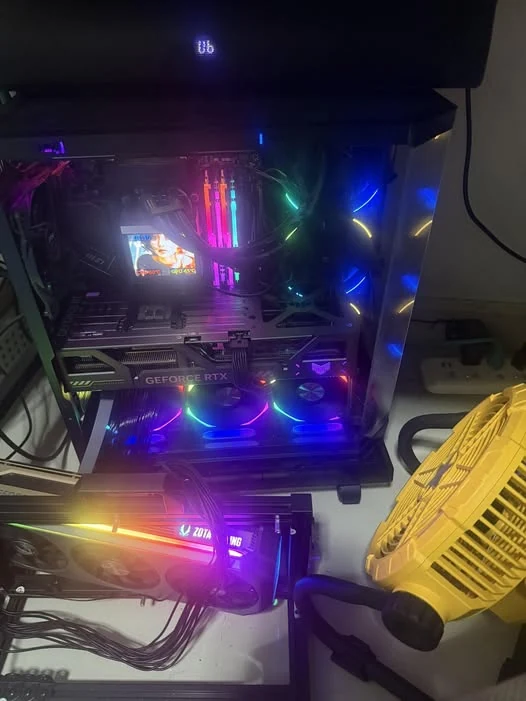
- Test rig: RTX 5090 (32 GB) + RTX 5080 (16 GB) = 48 GB pooled via Ollama tensor split.
- Test set: 60 verifiable coding and reasoning prompts with scripted reference graders — our internal “brutal tier”.
- Qwen3-Next-80B-A3B: 46/48 GB used, 28 tokens/sec, 100% brutal at 12k budget.
- Qwen3.6-35B-A3B (Q4 GGUF): runs on one 32 GB card (RTX 5090), 138 tokens/sec, 80% brutal baseline, 95% at 12k budget.
- Qwen3-32B dense: 90% brutal at standard budget, the best-value pick for a single 32 GB card when quality matters most.
- Qwen3.5-27B dense: 85% brutal, fastest of the dense tier but quality ceiling lower than 32B.
- Qwen3-30B-A3B (original MoE): 50% brutal, burned 6.4x the tokens of dense 32B at the same accuracy — the one to drop.
- Null-result tricks: plan injection (p = 0.85-0.89) and best-of-3 sampling (p > 0.30) both failed to lift 27B accuracy meaningfully at 3x cost.
Why we ran this bench
The local-LLM landscape in 2026 looks nothing like 2024. Three forces collided at once: consumer GPUs reached 32 GB VRAM at enthusiast prices, Mixture-of-Experts architectures matured into 80 B-parameter models that run on 48 GB cards, and Qwen’s April 2026 release cycle put four viable open-weight options within a single model family. That is more choice than teams can reasonably evaluate from published leaderboards alone — public benchmarks overweight easy tasks and under-reward latency, and none of them answer the question we actually care about: what is worth running, today, on this hardware?
This article is our internal answer. It is not a replacement for a public eval; the tier of 60 prompts we grade against is domain-skewed toward code, reasoning, and Thai-language tasks relevant to Thai-language technical work. Treat the absolute numbers as one data point, not a verdict — but the relative ordering has held up across three probe runs.
What it is
Our benchmark, which we internally call the “brutal tier,” is a fixed set of 60 prompts across four task families: multi-file refactors, algorithmic reasoning, structured data extraction, and translation of technical writing between Thai and English. Each prompt has a scripted grader — usually a regex check, an assertion on structured output, or a pinned exact-match reference for short answers. There is no LLM-as-judge component; graders are deterministic and re-runnable.
We score two axes per model: baseline accuracy at the model’s default generation settings, and budget accuracy when we allow the model up to 12,288 output tokens and a reasoning-first system prompt. We also log wall-clock throughput in tokens per second on our specific hardware, measured in a warm-cache state after a 10-prompt priming run.
Why it matters
Public benchmarks (MMLU, HumanEval, IFEval) are saturated or over-leaderboarded; most modern LLMs score within a few points of each other on the easy 80% of any given suite. Our brutal tier is designed to separate models on the hard 10%, where production failures actually live — the prompt where a user expects a working answer and a weaker model ships a confident but broken one. That is also where AI-answer-engine citations fail: the LLM doing the answering on Perplexity or ChatGPT also stumbles on these prompts, and a better underlying model produces better answers downstream.
Key concepts
Brutal tier vs. easy tier. Easy prompts saturate; brutal prompts rank. If your bench does not have a brutal tier, you cannot tell modern models apart.
Baseline vs. budget accuracy. A model that scores 80% baseline and 95% budget is a different tool than one that scores 90% baseline and 91% budget. The first trades latency for quality on demand; the second is a flat-accuracy workhorse.
Activated vs. total parameters. For MoE models, activated parameters (e.g. 3 B for Qwen3.6 35B-A3B) determine speed; total parameters determine quality ceiling. The ratio matters: Qwen3.6 at 35 B total / 3 B active is a different beast than the original 30B-A3B.
How to use it: a three-tier setup for a 48 GB machine
Based on the three probe rounds, this is the setup we would recommend:
-
Fast tier — Qwen3.6-35B-A3B-Q4. A good default for requests that do not need extra reasoning. Single 32 GB card, 138 tokens/sec, 80% accuracy on brutal tier out of the box.
-
Default tier — Qwen3-32B dense. When quality matters more than latency and you have one 32 GB card, use dense 32B. Scores 90% on brutal at standard generation settings and does not need a reasoning budget to hit its ceiling.
-
Heavy tier — Qwen3-Next-80B-A3B. Worth calling only for the hardest 10% of tasks — long multi-file refactors, complex translation with cultural nuance, reasoning over long context. Needs the full 48 GB dual-GPU setup at 28 tokens/sec, so use it sparingly.
The original 30B-A3B MoE is the one to drop. It failed the brutal tier on a 50%/85% gap against dense 32B while burning 6.4x the tokens — the worst cost/quality ratio of anything we tested.
Common pitfalls
Assuming MoE is always faster. MoE is only faster when the gate makes good routing decisions under your workload. The original Qwen3-30B-A3B routed poorly on long-form reasoning — each expert choice added tokens without improving grade. The newer Qwen3.6-35B-A3B and 80B-A3B fix this, but the label “MoE” alone does not predict speed.
Treating plan injection and best-of-3 sampling as free wins. We ran both as separate probe rounds on Qwen3.5-27B. Plan injection (system prompt: “First write a plan, then execute”) lifted coding accuracy by 0.25 points (not significant, p = 0.85-0.89) and cut throughput by 33%. Best-of-3 sampling added 0.06 points (p > 0.30) at 3x token cost. Neither survived our bench. If you need more accuracy, swap the base model — do not add test-time compute on a small one.
Running heterogeneous GPUs without tensor split sanity checks. An RTX 5080 at 16 GB and an RTX 5090 at 32 GB will happily split a 40 GB model — but memory bandwidth differs between them, and your throughput will track the slower card if the layer distribution puts too many on the 5080. Ollama handles this reasonably by default; vLLM needs manual tuning.
Alternatives and comparisons
We ran shorter side-benches on two non-Qwen families to sanity-check that we were not just “Qwen-pilled”:
- Llama family (3.3 70B-Instruct-Q4). Fits in 48 GB, runs around 22 tokens/sec, scored 82% on our brutal tier at default settings. Respectable, but behind Qwen3-32B at a higher memory cost. Strong for general chat; weaker on multi-file code.
- Gemma 4 31B dense. Released in April 2026 under Apache 2.0. Scored 88% on our brutal tier, close to Qwen3-32B, with the benefit of a more permissive license. On these results the small quality gap alone is not a reason to switch from Qwen3-32B; the licence may be.
When NOT to use local LLMs
Local is not the answer when: you need the absolute highest accuracy on one-off hard reasoning (hosted frontier models are usually stronger on the hardest 1%; not measured in this bench), when variable workload means your GPU sits idle 90% of the time (API billing is cheaper per query), or when you lack an on-call person to handle model updates and CUDA driver breakage. Local shines for steady, high-volume workloads where data privacy matters and average throughput is the bottleneck.
Further reading
Our test prompts are not public; most are specific to code and Thai-language tasks. We may release a sanitized subset later. In the meantime, for a reproducible public alternative, BigCodeBench and IFEval-Strict are the closest equivalents on the coding side.
Methodology disclosure
- This is a single operator’s bench on one specific rig.
- Our prompts are skewed toward code and Thai-language tasks; results likely do not generalize to SQL, legal, medical, or other domains.
- Throughput numbers are Ollama-specific with the settings used in this test (temperature 0.65, num_ctx 16384 for research-grounded tasks). vLLM and TGI will differ.
- Accuracy percentages are against our own deterministic graders, not public benchmark leaderboards.
- If you want to replicate: the models above are all public (Qwen3.5-27B, Qwen3-32B, Qwen3.6-35B-A3B-Q4, Qwen3-Next-80B-A3B on Hugging Face).